
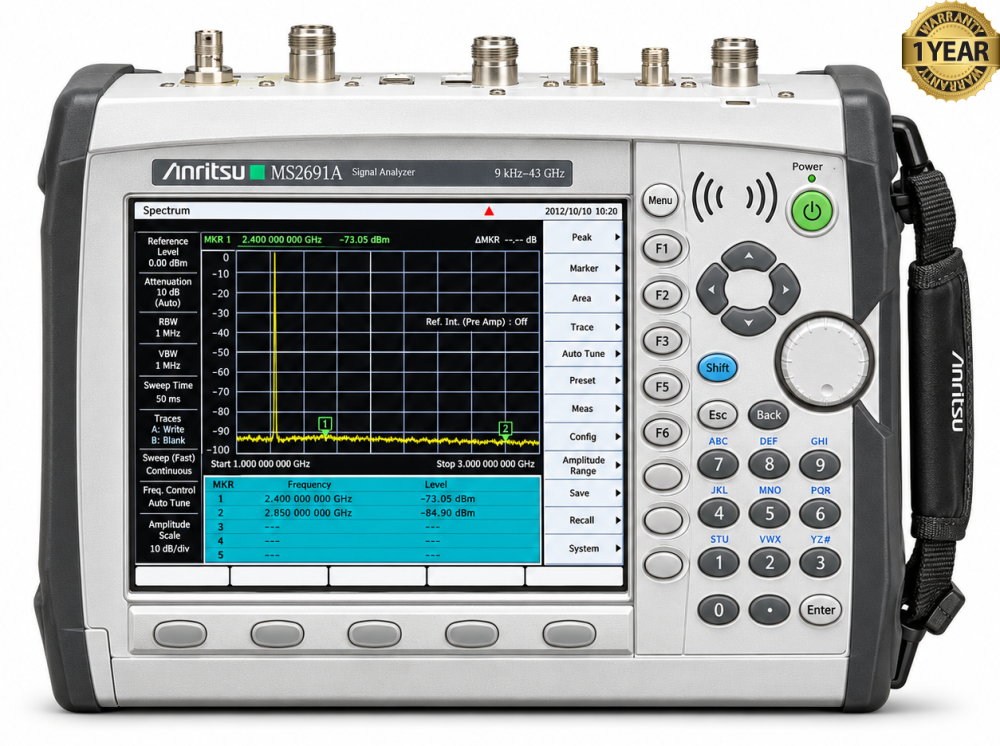

Anritsu MS2034A Handheld Vector Network Analyzer
Condition: Refurbished / Calibrated
Warranty: 1 YEAR WARRANTY
Shipping: USA & Worldwide
- Anritsu MS2034A Handheld Vector Network Analyzer (BC# -L/T*)
Anritsu MS2034A Handheld Vector Network Analyzer
The Anritsu MS2034A, part of the VNA Master series, is a portable electronic test instrument used to evaluate radio-frequency (RF) components and communication systems. It combines a two-port vector network analyzer covering 2 MHz to 4 GHz with a spectrum analyzer and power measurement capabilities. This combination allows technicians and engineers to perform several types of RF testing with one handheld instrument.
As a vector network analyzer, the MS2034A measures how a component changes the strength and phase of an RF signal. It sends a known test signal into a connected device and measures the signal reflected back or transmitted through it. These measurements help users evaluate cables, antennas, filters, and other components to understand how efficiently they transfer signals.
The instrument is particularly useful for troubleshooting cables and antenna systems. Return loss and voltage standing wave ratio (VSWR) measurements show how much signal is reflected because of an impedance mismatch, while cable loss measurements indicate how much signal strength a cable loses. Its distance-to-fault function helps locate problems along a cable, such as damaged sections or faulty connections, so technicians can identify where repairs are needed.
The MS2034A also includes a spectrum analyzer with a specified frequency range of 9 kHz to 4 GHz. This function displays signal strength across a range of frequencies, helping users examine transmitted signals and investigate unwanted RF energy. Its power measurement capabilities provide another way to assess signal levels, with the available measurements depending on the instrument’s configuration and connected accessories.
Overall, the MS2034A brings several RF diagnostic tools into a portable package for installation, maintenance, and troubleshooting work. It helps users determine whether components pass signals properly, whether antenna systems are well matched, and where cable faults may exist. Anritsu has discontinued this model and lists the MS2034B as its replacement, although the MS2034A’s measurement functions remain useful for systems within its operating range.
Features:
- Two-port vector network analyzer: Tests RF components from 2 MHz to 4 GHz.
- Spectrum analyzer: Examines signal strength across frequencies from 9 kHz to 4 GHz; some early units have a higher minimum frequency.
- Return loss measurement: Measures how much signal reflects back from a component or antenna.
- VSWR measurement: Evaluates impedance matching in cables and antenna systems.
- Cable loss measurement: Measures signal loss through RF cables.
- Distance-to-fault testing: Helps locate damaged cable sections and faulty connectors.
- Two-port gain measurement: Measures signal amplification or loss through a device.
- Phase measurement: Measures phase changes in reflected and transmitted signals.
- Group delay measurement: Evaluates signal delay through cables and components.
- Smith chart display: Shows impedance and matching characteristics graphically.
- Power measurement capabilities: Supports RF power measurements with the appropriate options and external sensors or detectors.
- Portable handheld design: Suitable for field installation, maintenance, and troubleshooting.
| Specification | Anritsu MS2034A |
|---|---|
| Instrument type | Handheld vector network and spectrum analyzer |
| VNA ports | 2 |
| VNA frequency range | 2 MHz–4 GHz |
| VNA frequency accuracy | 25 ppm |
| VNA frequency resolution | 10 Hz |
| Sweep data points | 137, 275, or 551 |
| Typical VNA output power | High: 0 dBm; low: −35 dBm |
| Corrected directivity | 42 dB |
| VNA dynamic range | 70 dB: 2–10 MHz; 80 dB: 10 MHz–3 GHz; 70 dB: above 3–4 GHz |
| Return loss range / resolution | 0–60 dB / 0.01 dB |
| VSWR range / resolution | 1–65 / 0.01 |
| Cable loss range / resolution | 0–30 dB / 0.01 dB |
| Phase range / resolution | −180° to +180° / 0.01° |
| Maximum distance-to-fault range | 1,500 m; depends on sweep settings and cable |
| Spectrum frequency range | 100 kHz–4 GHz in this datasheet revision |
| Spectrum tuning resolution | 1 Hz |
| Spectrum maximum continuous input | +30 dBm with 10 dB attenuation |
| RF impedance | 50 Ω |
| Operating temperature | −10°C to +55°C |
| Storage temperature | −51°C to +71°C |
| Dimensions | 315 × 211 × 97 mm |