
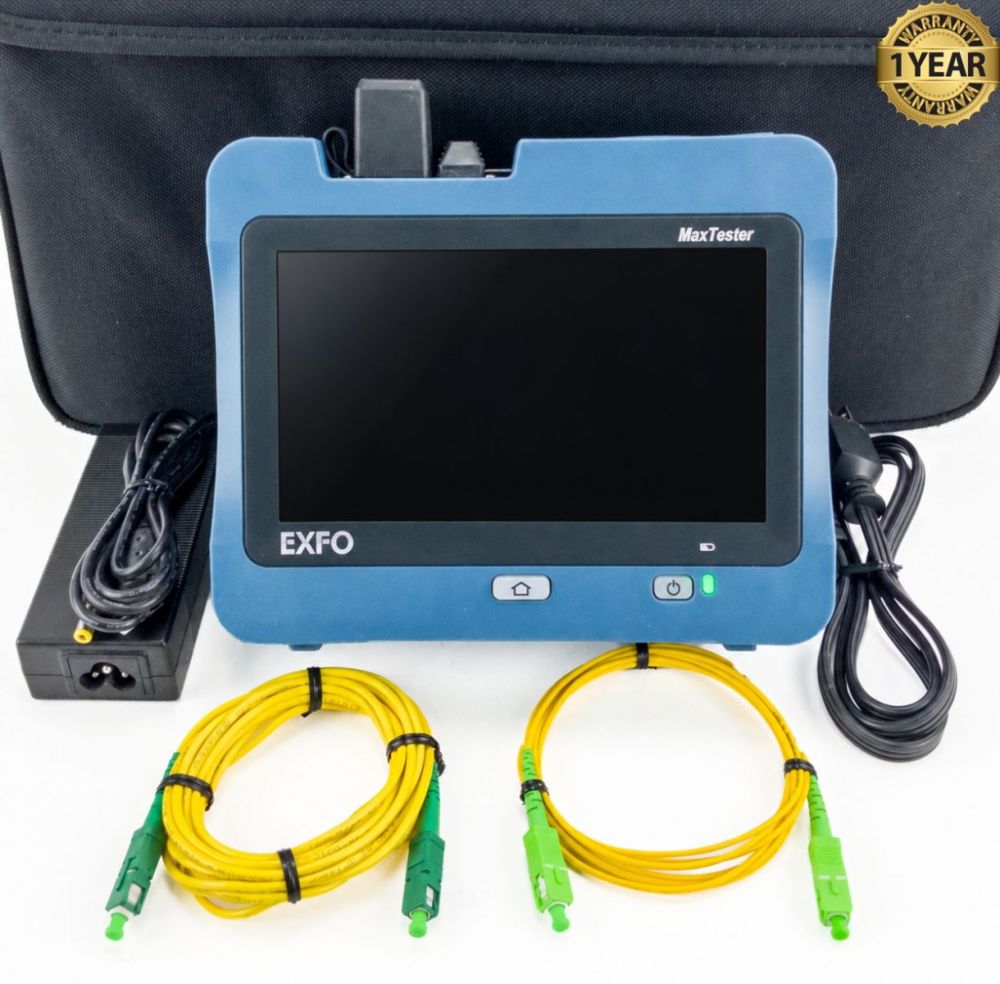


Exfo MAX-730D-SM3 PON/Metro SM OTDR 1310/1550/1625
Condition: Refurbished / Calibrated
Warranty: 1 YEAR WARRANTY
Shipping: USA & Worldwide
- Exfo MAX-730D-SM3 PON/Metro SM OTDR 1310/1550/1625 (BC# -L/T*)
- SM OTDR Option/Source:
- 1310nm
- 1550nm
- 1625nm
- Power Meter:
- 850nm
- 1300nm
- 1310nm
- 1490nm
- 1550nm
- 1625nm
- 1650nm
- SC Connector For Power Meter
- VFL
- SM OTDR Option/Source:
- (2) SC/APC Connectors
- AC Adapter/Charger
- Power Cord
- Carrying Case (G)
Exfo MAX-730D-SM3 PON/Metro SM OTDR 1310/1550/1625
The EXFO MAX-730D PON/Metro SM3 OTDR is a portable fiber optic test instrument used to inspect, troubleshoot, and document single-mode fiber networks. OTDR stands for Optical Time Domain Reflectometer. It sends short light pulses into a fiber and analyzes the light returning from it, producing a trace that helps technicians locate connections, splices, breaks, and other sources of signal loss.
The SM3 configuration tests at 1310, 1550, and 1625 nanometers. Comparing measurements at these wavelengths helps technicians assess fiber performance and investigate wavelength-dependent loss, including loss caused by excessive bending. This configuration is intended for single-mode fiber testing; EXFO lists separate configurations for filtered, live-fiber testing at 1650 nanometers.
Designed for passive optical networks and metropolitan fiber links, the MAX-730D helps technicians characterize both point-to-point connections and networks containing optical splitters. Its typical 39 dB dynamic range supports testing through higher-loss links, while its short dead zones help distinguish closely spaced events. These capabilities are useful during network installation, acceptance testing, maintenance, and fault location.
The instrument features a seven-inch touchscreen designed for outdoor viewing and a rechargeable battery rated for up to 12 hours under specified conditions. Its compact housing weighs approximately 1.5 kilograms with the battery installed. Internal storage holds approximately 20,000 typical OTDR traces, and USB and Ethernet connections support transferring results for review and documentation.
The MAX-730D also includes an optical connector health diagnostic and a field-replaceable Swap-Out connector, helping reduce downtime when the test connection becomes worn or damaged. Depending on the purchased configuration, it can support EXFO’s iOLM software and optional tools such as a power meter or visual fault locator. Together, these capabilities help technicians assess fiber links, identify problems, and maintain records of network condition.
Features:
- Three test wavelengths: 1310, 1550, and 1625 nm
- Single-mode fiber testing: For PON, access, and metro networks
- 39 dB typical dynamic range: Supports testing higher-loss fiber links
- Splitter testing: Designed to characterize passive optical networks
- Fault location: Identifies the distance to breaks, splices, connectors, and other events
- Loss and reflectance measurements: Helps assess connection and fiber quality
- Multiwavelength analysis: Helps identify bending-related loss
- Short dead zones: Typical 0.5 m event dead zone and 2.2 m attenuation dead zone under specified conditions
- Seven-inch touchscreen: Enhanced for outdoor viewing
- Rechargeable battery: Up to 12 hours of operation under specified conditions
- Compact design: Approximately 1.5 kg with battery
- Internal storage: 2 GB, holding approximately 20,000 typical OTDR traces
- Connectivity: Two USB 2.0 ports and an Ethernet port
- Swap-Out optical connector: Field-replaceable to reduce downtime
- Connector health diagnostics: Checks the condition of the OTDR connection
- EXFO Exchange compatibility: Supports managing and sharing test results
- Optional iOLM software: Provides automated analysis and a graphical link view
- Optional testing tools: Optical power meter, visual fault locator, and fiber inspection probe support.
| Specification | Details |
|---|---|
| Model | MAX-730D, SM3 configuration |
| Instrument type | Optical Time Domain Reflectometer |
| Fiber type | Single-mode |
| Test wavelengths | 1310 / 1550 / 1625 nm |
| Wavelength tolerances | ±20 / ±20 / ±10 nm, respectively |
| Typical dynamic range | 39 dB at each wavelength |
| Typical event dead zone | 0.5 m |
| Typical attenuation dead zone | 2.2 m |
| Typical PON dead zone | 30 m |
| Selectable distance range | 0.1–400 km |
| Pulse widths | 3–20,000 ns |
| Sampling resolution | 0.04–10 m |
| Maximum sampling points | 256,000 |
| Loss threshold | 0.01 dB |
| Loss resolution | 0.001 dB |
| Linearity | ±0.03 dB/dB |
| Typical reflectance accuracy | ±2 dB |
| Typical real-time refresh | 4 Hz |
| Measurement time | User-selectable |
| Display | 7-inch outdoor-enhanced touchscreen |
| Screen resolution | 800 × 480 pixels |
| Internal storage | 2 GB; approximately 20,000 typical traces |
| Interfaces | Two USB 2.0 ports; 10/100 Ethernet |
| Battery | Rechargeable lithium-polymer |
| Battery runtime | Up to 12 hours under specified conditions |
| AC adapter input | 100–240 V AC, 50–60 Hz |
| Operating temperature | −10°C to +50°C |
| Operating humidity | 0–95%, noncondensing |
| Optical connector | Field-replaceable Swap-Out design |
| Optional capabilities | iOLM, power meter, visual fault locator |