
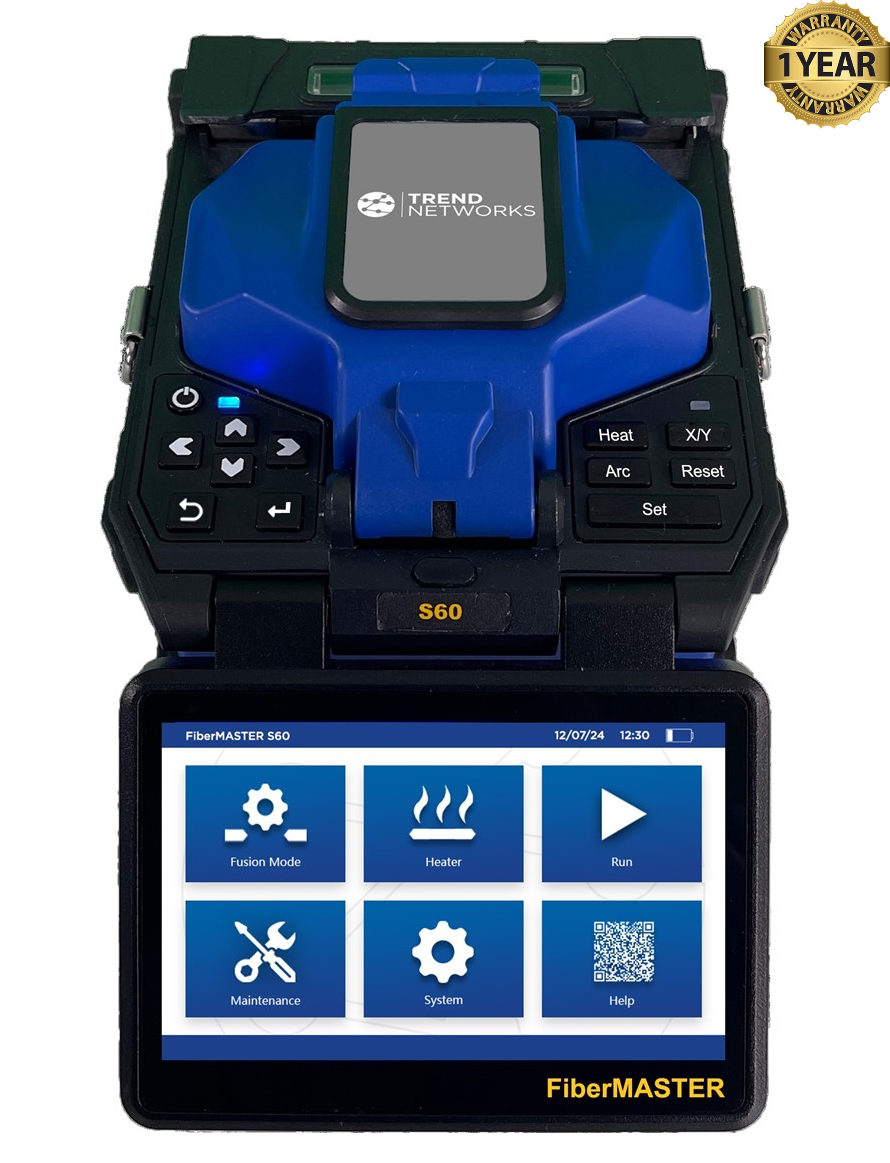

Trend Networks FiberMaster S60 Core Alignment Fusion Splicer
Condition: Refurbished / Calibrated
Warranty: 1 Year Warranty
Shipping: USA & Worldwide
- Trend Networks FiberMaster S60 Core Alignment Fusion Splicer (BC# -L/T*)
- Carrying Case (G)
Trend Networks FiberMaster S60 Core Alignment Fusion Splicer
The TREND Networks FiberMASTER S60 Core Alignment Fusion Splicer is a portable machine that permanently joins two optical fibers. Technicians use it to install, extend, and repair fiber-optic cables that carry information as pulses of light. It is designed especially for telecommunications trunk networks and jobs requiring large numbers of splices.
The S60 uses active core alignment to line up the tiny, light-carrying centers of the fibers before joining them. Its camera system and six motors precisely position the fiber ends. Accurate alignment helps minimize the amount of light lost at the connection, supporting reliable signal transmission.
To make a splice, the technician strips the protective coating from each fiber, cleans it, and cuts the end precisely with a fiber cleaver. The prepared fibers are placed in the S60, which aligns them and uses an electrical arc to fuse the glass ends together. A protective sleeve is then heated over the joint to reinforce it.
The S60 combines fast operation with tools that help technicians inspect their work. TREND Networks lists an average splicing time of six seconds and a typical sleeve-heating time of 18 seconds. Its five-inch color touchscreen displays fiber images at 400× magnification, while automatic modes detect the fiber type and select suitable splicing settings.
For field work, the S60’s battery is rated for approximately 280 splice-and-heat cycles, and its memory can store 10,000 results plus 100 images. TREND Networks advertises splice loss as low as 0.01 dB, although actual results depend on fiber preparation and operating conditions. Its main purpose is to help technicians create strong, consistent connections with minimal signal loss.
Features:
- Active core alignment: Uses cameras and six motors to precisely align the light-carrying cores of two fibers.
- Automatic fiber detection: Identifies fiber types and selects suitable splicing settings.
- Fast splicing: Average splice time of 6 seconds.
- Built-in sleeve heater: Protects the finished splice, with a typical heating time of 18 seconds.
- Low splice loss: Manufacturer-advertised loss as low as 0.01 dB, depending on preparation and conditions.
- 5-inch color touchscreen: Provides controls and a clear view of the fibers.
- 400× magnification: Helps technicians inspect fiber alignment and the splice.
- Rechargeable battery: Rated for approximately 280 splice-and-heat cycles.
- Internal storage: Saves up to 10,000 splice results and 100 images.
- Field-ready construction: Designed for telecommunications installations and high-volume splicing.
| Feature | Specification |
|---|---|
| Manufacturer | TREND Networks |
| Model | FiberMASTER S60 |
| Alignment | 3-axis active core alignment |
| Motors | 6 |
| Supported fibers | Single-mode and multimode |
| Splicing capacity | Single fiber |
| Fiber standards | G.651, G.652, G.653, G.654, G.655, G.657 |
| Cladding diameter | 80–150 µm |
| Coating diameter | 160–3,000 µm |
| Average splice loss | G.651: 0.01 dB; G.652/G.657: 0.02 dB; G.653/G.654/G.655: 0.04 dB |
| Average return loss | Greater than 60 dB |
| Splicing time | Fast SM mode: 5–7 seconds; automatic mode: 11–15 seconds |
| Sleeve heating time | 60 mm sleeve: 14–16 seconds; 40 mm sleeve: 12 seconds |
| Display | 5-inch color touchscreen; 800 × 480 pixels |
| Magnification | Individual X/Y view: 400×; combined view: 200× |
| Splicing programs | 50 predefined; 50 user-defined |
| Storage | 10,000 splice records; 200 splice images |
| Data export | CSV records; bitmap images; USB 2.0 |
| Electrode life | Approximately 5,000 splices |
| Battery | Rechargeable lithium-ion; 10.8 V, 5,200 mAh |
| Battery capacity | More than 280 splice-and-heat cycles, typical |
| Charging time | Approximately 3.5 hours |
| Operating temperature | −10°C to +50°C |