
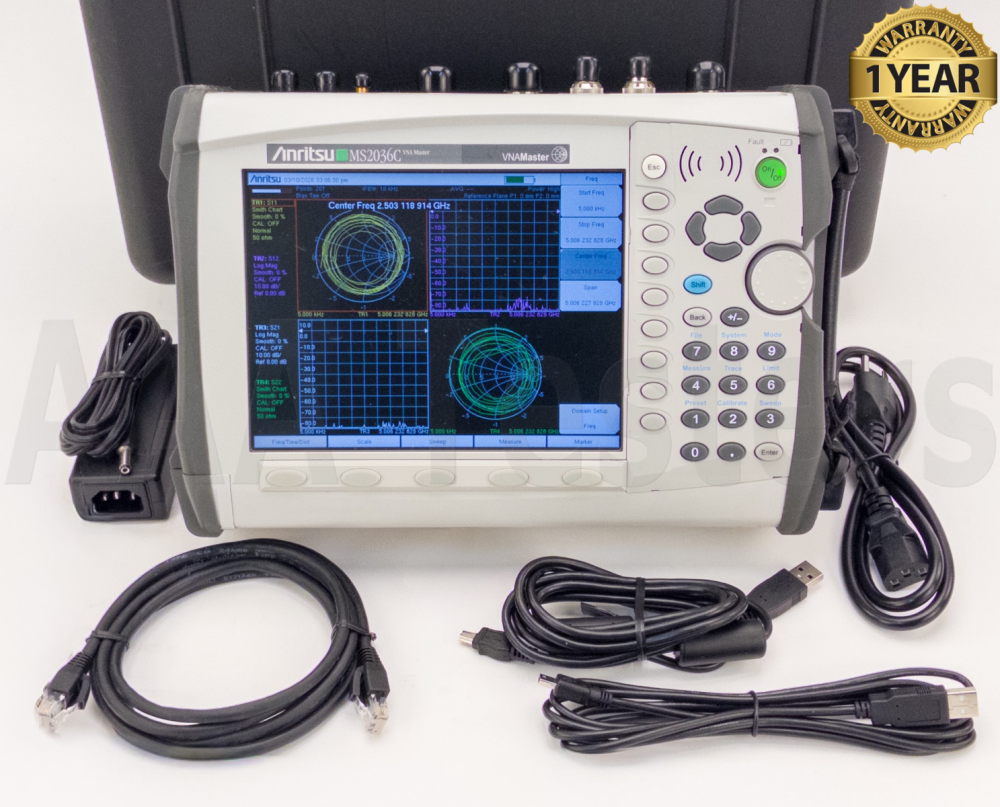


Anritsu MS2036C 9 GHz 2-Port VNA Master & Spectrum Analyzer
Condition: Refurbished / Calibrated
Warranty: 1 YEAR WARRANTY
Shipping: USA & Worldwide
- Anritsu MS2036C VNA Master Spectrum Analyzer w/ Option: (BC# -L/T*)
- Option 2: Time Domain Analysis
- Option 10: Internal Bias Tee
- Option 15: Vector Voltmeter
- AC Adapter/Charger
- Power Cord
- USB PC Interface Cable
- Ethernet Cable
- Carrying Case
Anritsu MS2036C 6GHz VNA Master w/ 9 GHz Spectrum Analysis
The VNA Master MS2036C is a high performance, fully reversing handheld vector network analyzers (VNA) with frequency coverage from practically DC (5 kHz) to 6 GHz. With a high-performance spectrum analyzer covering 9 kHz to 9 GHz, the VNA Master series transforms into a powerful multi-function instrument capable of enabling field technicians and engineers to accurately install, troubleshoot, and maintain complex communication systems with the highest degree of accuracy and reliability. Whether it’s a mission critical military application or simply a consumer services type of application, the VNA Master series will provide accurate and dependable measurements – anytime, anywhere.
Vector Analyzer Key Features
- True 2-path 2-port fully-reversing VNA; measures and displays all S-parameters with a single connection
- 5 kHz to 6 GHz
- Ultra-fast 350 μsec/data point sweep speed, ideal for filter tuning with ultimate flexibility in the number of points from 2 to 4001
- 12-term error correction algorithm
- Vector Voltmeter option, ideal for cable phase matching
- Time Domain option for precise Time or Distance Domain diagnostics, includes Gated Time Domain, LP Processing, and Phasor Impulse mode
Spectrum Analyzer Key Features
- 9 kHz to 9 GHz
- Detectors: Peak, Negative, Sample, Quasi-peak, and RMS
- Markers: 6, each with a Delta Marker, or 1 Reference with 6 Deltas
- Interference Analyzer Option: Spectrogram, Signal Strength, RSSI
- AM/FM/PM Modulation Analyzer Option: Carrier Power, Center Frequency, Occupied Bandwidth, Audio Waveform & Spectrum, Deviation, SINAD, THD
Specifications:
| VNA PERFORMANCE | |
| Frequency | Frequency Range MS2036C: 5 kHz to 6 GHz Frequency Accuracy: ±1.5 ppm Frequency Resolution: 1 Hz to 375 MHz, 10 Hz to 6 GHz, and 100 Hz to 20 GHz |
| Test Port Power | 5 kHz to 3 GHz High Port: +3 Low Port: -25 > 3 GHz to 6 GHz High Port: -3 Low Port: -25 > 6 GHz to 20 GHz High Port: -3 Low Port: -15 |
| Transmission Dynamic Range | 5 kHz to 2 MHz: 85 dB > 2 MHz to 3 GHz: 100 dB > 3 GHz to 6 GHz: 90 dB > 6 GHz to 20 GHz: 85 dB |
| Sweep Speed | 5 kHz to 6 GHz: 350 μs/point typical > 6 GHz to 20 GHz: 650 μs/point typical |
| High-Level Noise | 5 kHz to 6 GHz Magnitude: 0.004 dB (rms) Phase: 0.040 deg > 6 GHz to 20 GHz Magnitude: 0.010 dB (rms) Phase: 0.050 deg |
| Noise Floor | 5 kHz to 2 MHz: –85 dBm typical > 2 MHz to 3 GHz: –100 dBm typical > 3 GHz to 6 GHz: –96 dBm typical > 6 GHz to 20 GHz: –91 dBm typical |
| Temperature Stability | 5 kHz to 10 GHz Magnitude: 0.018 dB/ºC Phase: 0.160 deg/ºC > 10 GHz to 20 GHz Magnitude: 0.070 dB/ºC Phase: 0.800 deg/ºC |
| SPECTRUM ANAYZER PERFORMANCE | |
| Measurements | Smart Measurements: Field Strength (dBm/m 2, dBV/m, dBmV/m, dBμV/m, V/m, Watt/m2, dBW/m 2, A/m, dBA/m, or Watt/cm 2) Occupied Bandwidth (measures 99 % to 1 % power channel of a signal, or N dB from center of signal) Channel Power (measures the total power in a specified bandwidth) ACPR (Adjacent Channel Power Ratio) Emission Mask (recall limit lines as emission mask) Spurious Emissions (measures up to 32 segments with independent setups and limits) C/I (Carrier-to-Interference ratio) AM/FM/SSB Demodulation (AM, wide/narrow FM, upper/lower SSB (audio only)) PIM Hunting |
| Setup Parameters | Frequency: Center/Start/Stop, Span, Freq Step, Freq Offset, Signal Standard, Channel #, Channel Increment Amplitude: Reference Level (RL), Scale, Attenuation Auto/Level, RL Offset, Units (dBm, dBV, dBmV, dBμV, Volt, Watt, dBW, A, dBA), Pre-Amp On/Off, Detection (Peak, RMS/Avg, Negative Peak, Sample, Quasi-Peak) Span: Span, Span Up/Down (1-2-5), Full Span, Zero Span, Last Span Bandwidth: RBW, Auto RBW, VBW, Auto VBW, VBW/Avg Type (Linear, Log), RBW/VBW Ratio, Span/RBW Ratio Impedance: 50 Ω, 75 Ω; external pad required for 75 Ω operation |
| Sweep Functions | Sweep: Single/Continuous, Sweep Time Sweep Mode: Fast (up to 100x faster than Performance), Performance, No FFT, Burst Detect (1000x Fast in 15 MHz span) Triggers: Free Run, External, Video, IF Power, Force Trigger Once Trigger Parameters: Delay, Level, Slope, Hysteresis, Holdoff (availability varies with trigger) |
| Trace Functions | Traces: Up to three Traces (A, B, C), View/Blank, Write/Hold, Trace A/B/C Operations Trace A Operations: Normal, Max Hold, Min Hold, Average, # of Averages, (always the live trace) Trace B Operations: A → B, B ← → C, Max Hold, Min Hold Trace C Operations: A → C, B ← → C, Max Hold, Min Hold, A – B → C, B – A → C, Relative Reference (dB), Scale |
| Marker Functions | Markers: Markers 1-6 each with a Delta Marker, or Marker 1 Reference with Six Delta Markers, Marker Table (On/Off/Large), All Markers Off Marker Types: Style (Fixed/Tracking), Noise Marker, Frequency Counter Marker Marker Auto-Position: Peak Search, Next Peak (Right/Left), Peak Threshold %, Set Marker to Channel, Marker Frequency to Center, Delta Marker to Span, Marker to Reference Level Marker Table: 1-6 markers frequency and amplitude, plus delta markers frequency offset and amplitude |
| Limit Line Functions | Available Spans: > 0 Hz Limit Lines: Upper/Lower, On/Off, Edit, Move, Envelope, Advanced, Limit Alarm, Default Limit Limit Line Edit: Frequency, Amplitude, Add Point, Add Vertical, Delete Point, Next Point Left/Right Limit Line Move: To Current Center Frequency, By dB or Hz, To Marker 1, Offset from Marker 1 Limit Line Envelope: Create Envelope, Update Amplitude, Number of Points (2-41), Offset, Shape Square/Slope Limit Line Advanced: Type (Absolute/Relative), Mirror, Save/Recall Save on Event: When Limit Crossed |
| Frequency | MS2036C: 9 kHz to 9 GHz Tuning Resolution: 1 Hz Frequency Reference: Aging: ± 1.0 x 10 –6 per year for 10 years Accuracy: ± 0.3 x 10⁻⁶ (25 °C ± 25 °C) plus aging External Frequency Reference (MHz): 1, 1.2288, 1.544, 2.048, 2.4576, 4.8, 4.9152, 5, 9.8304, 10, 13, 19.6608 (auto-sensing) Sweep Time: 7 μs to 3600 s in zero span Sweep Time Accuracy: ± 2 % in zero span |
| Bandwidth | Resolution Bandwidth (RBW): 1 Hz to 10 MHz in 1–3 sequence ± 10 % (–3 dB bandwidth) Video Bandwidth (VBW): 1 Hz to 10 MHz in 1–3 sequence (–3 dB bandwidth) RBW with Quasi-Peak Detection: 200 Hz, 9 kHz, 120 kHz (–6 dB bandwidth) VBW with Quasi-Peak Detection: Auto VBW is On, RBW/VBW = 1 VBW/Average Type: Linear/Log |
| Spectral Purity | 10 kHz: –106 dBc/Hz 100 kHz: –110 dBc/Hz 1 MHz: –116 dBc/Hz 10 MHz: –129 dBc/Hz |
| Amplitude Ranges | Dynamic Range: >106 dB minimum at 2.4 GHz, 2/3 (TOI-DANL) in 1 Hz RBW Measurement Range: DANL to +30 dBm Display Range: 1 to 15 dB/div in 1 dB steps, ten divisions displayed Reference Level Range: –150 dBm to +30 dBm Attenuator Resolution: 0 to 65 dB, 5.0 dB steps Reference Level Offset: 99.9 dB External Loss to 99.9 dB External Gain Amplitude Units: Log Scale Modes: dBW, dBm, dBμW, dBV, dBmV, dBμV, dBA, dBmA, dBμA Linear Scale Modes: fV, nV, μV, mV, V, fW, pW, nW, μW, mW, W, pA, nA, μA, mA, A Maximum Continuous Input: +30 dBm Peak typical, ± 50 VDC (≥ 10 dB Attenuation) +23 dBm Peak typical, ± 50 VDC (< 10 dB Attenuation) +13 dBm Peak typical, ± 50 VDC (Preamp = On) |
| DANL | 10 MHz to 4 GHz Preamp off: –148 dBm > 4 GHz to 9 GHz Preamp off: –145 dBm > 9 GHz to 13 GHz Preamp off: –139 dBm > 13 GHz to 20 GHz Preamp off: –142 dBm |
| Spurs | < 13 GHz Preamp off: –90 dBm 13 GHz to 20 GHz Preamp off: -85 dBm Input-Related Spurious (–30 dBm input) Preamp off: –60 dBc |
| Third-Order Intercept | 2.4 GHz: +14 dBm minimum 50 MHz to 20 GHz: +20 dBm typical |
| P1dB | < 4 GHz: +5 dBm nominal 4 GHz to 20 GHz: +12 dBm nominal |
| Second Harmonic Distortion | 50 MHz: –54 dBc maximum < 4 GHz: –60 dBc typical ≥ 4 GHz: –75 dBc typical |
| VSWR | ≤ 20 GHz 1.5:1 typical |