
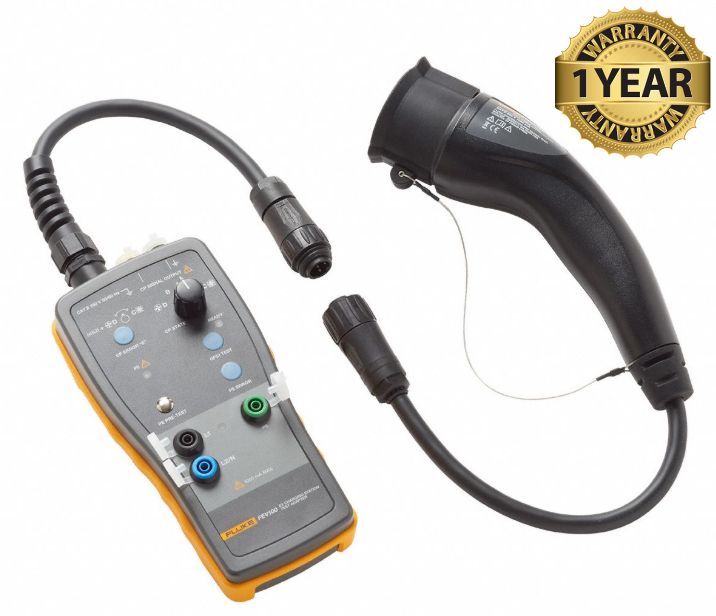

Fluke FEV100 EV Charging Station Analyzer
Condition: Refurbished/Calibrated
Warranty: 1 Year Warranty
Shipping: USA & Worldwide
- Fluke FEV100 EV Charging Station Analyzer(BC# -L/T*)
- FEV-CON-TY1 Connector Cable
- Carrying Case
Fluke FEV100 EV Charging Station Analyzer
Test the safety and performance of a type 1, level 1 or level 2 electric vehicle ac charging stations (EVSEs) with the Fluke FEV100. This test adapter simulates the presence of an electrical vehicle, allowing you to conduct tests in combination with appropriate test instruments such as a digital multimeter or oscilloscope. Use the FEV100 to verify an EVSE is working properly after install and during periodic maintenance, or troubleshoot an EVSE if it is not delivering the appropriate charge.
Electrical safety
EVSE charging cables may become damaged over the course of use, increasing electric shock risks to users. Stay protected from and check risk of electric shock with the GFCI trip test. This function verifies the breaker of the EVSE is connected by detecting ground faults. Additionally, the PE grounding protection pre-test verifies that there is no presence of dangerous voltage at the ground terminal.
Simplicity and convenience
Perform a variety of tests including ground fault checks, insulation of wires, measuring voltage and duty cycle to see max current available for charging all in one adapter that safely integrates with the Fluke portfolio of test and measurement tools. There is no need to bring an electric vehicle onsite for EVSE troubleshooting: the adapter acts as an electric vehicle when connected to an EVSE for easy performance and maintenance testing.
Specifications:
| General specifications | |
| Input voltage | UL1/N = 120 V, UL2/N = 120 V, UL1/L2 = 208 V, 60 Hz (three-phase system) or UL1/N = 120 V, UL2/N = 120 V, UL1/L2 = 240 V, 60 Hz (single-phase system), ±10% voltage fluctuations from nominal |
| EV connector (EVC-13) | SAE J1772 socket, 16 A (type 1, 5P single-phase) |
| Internal power consumption | 2 W max. |
| Operating temperature | -4 °F to 104 °F (-20 °C to 40 °C) |
| Storage temperature | -4 °F to 122 °F (-20 °C to 50 °C) |
| Operating humidity range | 10 % to 85 % relative humidity non-condensing |
| Storage relative humidity | 0 % to 85 % non-condensing |
| Operating altitude | 6561 ft (2000 m) max. |
| Dimensions (H × W × D) | Approx. 8.66 x 4.33 x 1.77 in (220 x 110 × 45 mm) without cable assembly |
| Weight | Approx. 4.4 lb (2 kg) |
| Safety standards | IEC 61010-1, Pollution Degree 2 IEC 61010-2-030 |
| Measurement category | CAT II 250 V |
| IP protection class | IP54 |
| Electromagnetic Compatibility (EMC) | |
| International | IEC 61326-1: Basic Electromagnetic Environment CISPR 11: Group 1, Class A Group 1: Equipment has intentionally generated and/or uses conductively-coupled radio frequency energy that is necessary for the internal function of the equipment itself. Class A: Equipment is suitable for use in all establishments other than domestic and those directly connected to a low-voltage power supply network that supplies buildings used for domestic purposes. There may be potential difficulties in ensuring electromagnetic compatibility in other environments due to conducted and radiated disturbances. Caution: This equipment is not intended for use in residential environments and may not provide adequate protection to radio reception in such environments. |
| USA (FCC) | 47 CFR 15 subpart B. This product is considered an exempt device per clause 15.103. |
| Functions | |
| CP States | A, B, C, D |
| CP Error “E” | On/off |
| PE Error | On/off |
| GFCI Test | Yes, test resistor of 2 kΩ connected between L1 and PE, time limitation 40 ms |
| PE Pre-Test (typical) | Visible indication >30 V on PE conductor |
| Outputs (for test purpose only) | |
| Measuring terminals L1, L2/N, PE |
Max. 250 V 50/60 Hz, CAT II 250 V |
| CP signal output terminals | Approx. ±12 V (under normal conditions), in case of wrong wiring or error of the charging station these terminals can be hazardous ≥ max. 250 V against PE |